

Source: Photo by Baylor Spears/Wisconsin Examiner
Wisconsin close to being the 49th state to extend postpartum Medicaid coverage to a year
During its final planned day of legislative business this year, the Wisconsin Assembly passed a bill to ensure health care coverage of screenings for women at high risk of breast cancer and a bill to extend postpartum Medicaid coverage to a year. Republican lawmakers announced Wednesday evening that they would vote on the bills, breaking
Feb 20, 2026, 8:55 AM CST


Share
Originally published by Wisconsin Examiner, a nonprofit news organization.
Republican lawmakers announced Wednesday evening that they would vote on the bills, breaking gridlock on the issues which for years was held up by Assembly Speaker Robin Vos (R-Rochester). Vos, who announced his retirement at the beginning of the floor session Thursday, reversed his position and voted in favor of both bills.
Each bill passed the Senate in nearly unanimous votes last year, and the Assembly concurring votes will send the bills to Gov. Tony Evers for a signature.
Lawmakers honor Gail Zeemer as they pass breast cancer screening bill
SB 264 requires health insurance policies to provide coverage for diagnostic breast examinations and for supplemental breast screening examinations for women with dense breast tissue. The bill would require coverage to include no patient cost-sharing.
The family of Gail Zeemer, a Neenah woman who spent time advocating for the legislation before her death from breast cancer in 2024, sat in the Assembly gallery. Zeemer, who had dense breast tissue, was diagnosed with cancer at a late stage after not receiving additional screening. She battled cancer for eight years and passed away in June 2024 at the age of 56.
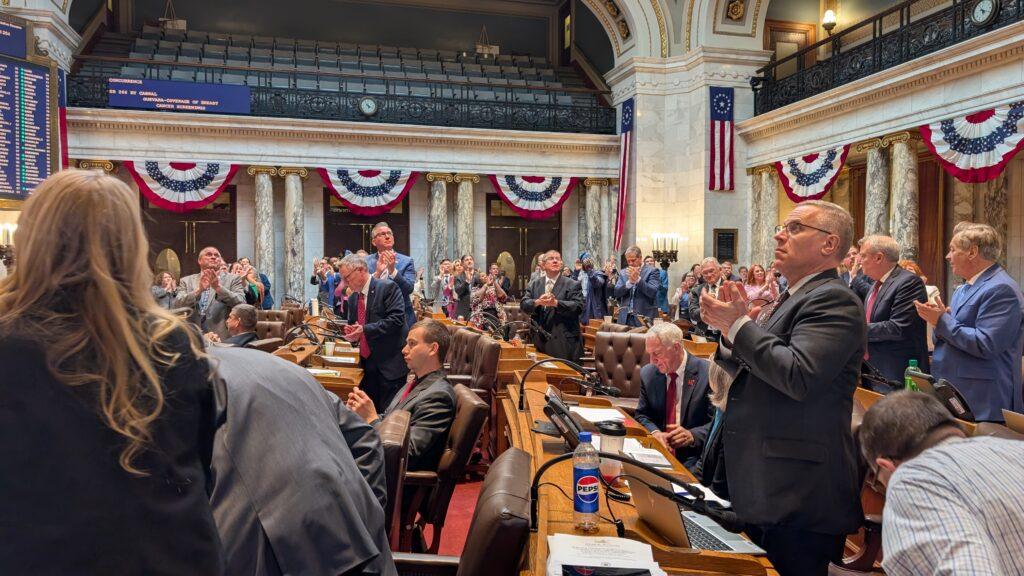
Lawmakers applauded her family after voting to concur in the bill, named “Gail’s Law.” It passed in a unanimous 96-0 vote.
Rep. Robyn Vining (D-Wauwatosa) spoke about listening to testimony from Zeemer during a hearing on the bill prior to her death in the Assembly Health committee.
“She was full of strength and determination,” Vining said. “This year, as we’ve heard testimony, her absence was felt in the room. Today is the day that she fought for, and I am so sorry that Gail is not here with us today. Gail’s law will save lives. It will prevent preventable deaths.”
“You didn’t give up. You didn’t take no for an answer,” Vining said of Zeemer’s family and other advocates for the bills.
Several lawmakers, including Rep. Nate Gustafson (R-Omro) and Rep. Amanda Nedweski (R-Pleasant Prairie), teared up as they spoke of their support for the legislation.
“It’s about families,” Nedweski said of the bill. “Too many husbands have lost their wives to breast cancer, too many parents have had to say goodbye to a daughter too soon, and too many children have seen their mother’s hair fall out and have had to cry themselves to sleep while their mothers went through chemo, surgery and radiation, sometimes only to be told the cancer is back, and there are no other options.”
Nedweski said the bill takes an important step to “help children keep their moms.”
“Mammography simply does not work for everyone,” she added.
Nedweski said the bill is a “wise investment,” noting that it is why Texas and Florida have adopted similar policies. “Gail’s law is not only life-saving, it is cost-saving. Detecting cancer early not only drastically increases survival rates, it means that treatment costs will be lower for patients and for families.”
Women with dense breast tissue have a higher risk of breast cancer and it can make it harder for radiologists to see cancer on mammograms, according to the American Cancer Society.
Insurance policies in Wisconsin are already required to provide coverage for two mammograms for women between the ages of 45 and 49 and annual screenings for women over the age of 50, but insurance companies are not required to cover additional screenings for women with dense breast tissue or at higher risk.
Bipartisan support for the bill did not prevent partisan bickering during debate. Republican lawmakers complained in a press conference announcing the bill scheduling and again on the floor about Democratic lawmakers’ prior actions urging a vote.
Rep. Barbara Dittrich (R-Oconomowoc) said that the eight Republican Assembly lawmakers were the “true heroes who fought for where we are today.”
“I celebrate them, rather than the tantrum throwing we saw leading up to this,” she said.
Others highlighted the bipartisan nature of the bills.
Rep. Lee Snodgrass (D-Appleton) thanked Sen. Rachael Cabral-Guevara (R-Appleton), a key supporter of the legislation, and Rep. Dean Kaufert (R-Neenah), who called for lawmakers to go to partisan caucus to discuss the measure on Wednesday. GOP lawmakers credit discussion during the caucus for the recent breakthrough.
“I know that this body is contentious often. I know that some of us don’t even like each other, but when we can come together and do something good for women’s health and the people of Wisconsin,” Snodgrass said, “it’s truly a victory.”
Some lawmakers said that Wisconsin still needs to do more to ensure that people can access health care in the state.
Margaret Arney (D-Wauwatosa) called the passage of the bill a “victory” but a “small step on a long road.”
“We need to seriously stare in the face of what it takes for people to afford health care,” Arney said. “All the people in Wisconsin deserve to have health security and I invite us to take that step together.”
Postpartum Medicaid extension
Wisconsin is poised to become the 49th state to accept a federal expansion of Medicaid coverage for women for one year after they give birth after the state Assembly approved SB 23.
The bill passed 95-1. Rep. Shae Sortwell (R-Two Rivers) is the only lawmaker who voted against the bill.
Evers, who most recently called on lawmakers to pass the bill and send it to him at his State of the State address on Tuesday evening, is likely to sign it.
Pregnant women can receive Medicaid coverage in Wisconsin if they have an annual income of up to 306% of the federal poverty level, however, currently they risk losing that coverage 60 days after giving birth.
Rep. Patrick Snyder (R-Weston), the lead Assembly author on the bill, said he picked up the “mantle” on the issue because of what he heard while knocking doors during the campaign cycle. A previous author on the bill was former Republican Rep. Donna Rozar, who lost her reelection bid in 2024.
Snyder also doubled down on criticizing Democratic lawmakers for their efforts to force a vote on the issue. “I had a night’s sleep and I realized that a lot of my Democrat colleagues who I’m friends with are following orders,” he said.
“Thank goodness we beat Arkansas,” Snyder said, referring to the only other state in the U.S. that has not extended postpartum Medicaid coverage for a year. “Strong families will mean strong Wisconsin. That’s what I put my faith in, not trying to score political points.”
Rep. Deb Andraca (D-Whitefish Bay) struck a more cordial tone.
“I want to thank everyone here who changed their mind,” Andraca said. “That’s not easy.”

Want More Local News?

Civic Media
Civic Media Inc.
The Civic Media App
Put us in your pocket.