





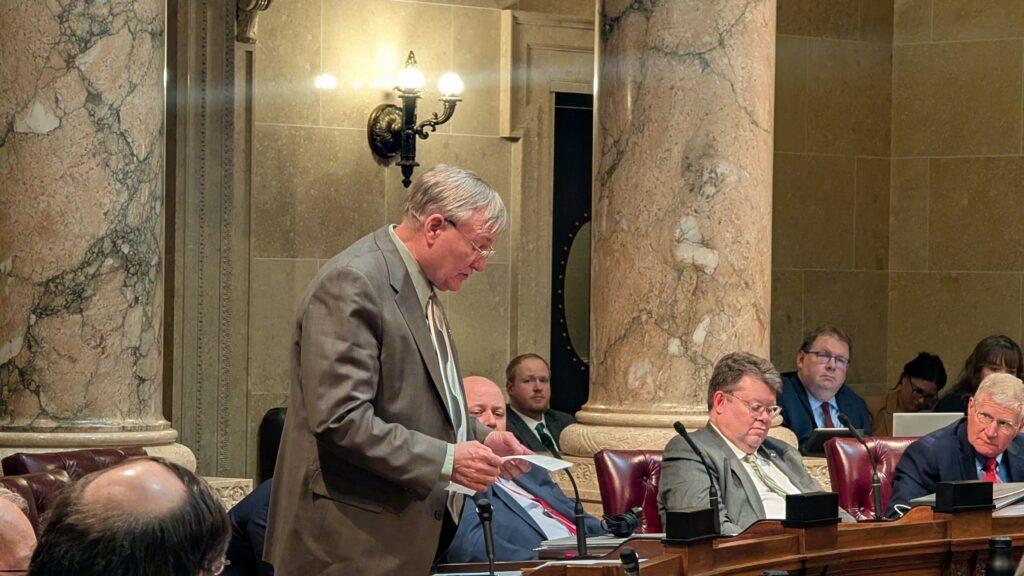


The potential for Republicans to lose the Senate majority in the next election cycle cast a shadow over the Wisconsin State Senate’s last regular day of work this legislative session. Senate Majority Leader Devin LeMahieu (R-Oostburg) faced criticism from his members for bringing bills to a vote without a majority of support from his caucus and one longtime Republican announced his retirement.
Wisconsin Republicans currently hold an 18-seat majority in the 33-seat state Senate. The 17 odd-numbered seats will be up for election this year for the first time under the new maps adopted in 2024, which puts the majority in play this November. Democrats have not been in the Senate or Assembly majority since the 2009-10 session.
LeMahieu drew fire from members of his own party for allowing votes on bills supported by Democrats to legalize sports betting in Wisconsin and to provide funding to the University of Wisconsin to help pay student athletes for their name, image and likeness. Some Republicans who opposed the bills said it would lead to LeMahieu losing his leadership position and to Republicans losing their Senate majority in November.
Sen. Steve Nass (R-Whitewater), who is one of the most conservative lawmakers in the state Senate and is retiring at the end of his term, said voters will hold Republican lawmakers “to account for selling out their interests” in November.
“The passage of these two unpopular bills will help pave the way to minority status for Republicans come November,” Nass, who has served in the Legislature since 1991, said in a statement.
Over the weekend, Sen. Chris Kapenga (R-Delafield) suggested to WISN 12 that LeMahieu could lose his leadership position if the Senate passed the bills by relying on Democratic votes. He said it was “shameful” that the Senate planned to take up the bills and that he was concerned by the lack of a “coalescence of the Republican votes.”
“Historically, usually a majority leader does not come back if he breaks the rule of 17,” Kapenga said, referring to an unwritten rule that requires obtaining the votes of 17 Republicans or an all-GOP majority to pass any bill through the Senate. “So, I hope the majority leader takes that into account.”
Last month at a WisPolitics lunch, LeMahieu said that the “rule of 17” was just “essentially what members use to try to kill bills that they don’t like.” He previously broke that informal rule to pass the 2025-27 state budget with Democratic votes.
Assembly Speaker Robin Vos (R-Rochester), the longest-serving Assembly speaker in state history, who is retiring at the end of his term, defended LeMahieu’s work as leader including his decision to bring the NIL and sports-betting bills to the floor. He told reporters at a Tuesday WisPolitics event that those suggesting that LeMahieu would lose his job over it don’t “really know how the world works.”
“Sometimes you have to have things pass because it’s in the best interest of the state, and sometimes if you can’t convince people, you gotta find out how to get there,” Vos said. “I feel like the members in our chamber are sometimes a little bit more open to being persuaded than some of the Senate Republicans are. I have said the hardest job in the Capitol is being the Senate majority leader. It was under [now-U.S. Rep.] Scott Fitzgerald. It was under Devin LeMahieu, so I hope that people will respect the fact that he’s doing what he thinks is right.”
Vos also said during the event that a lack of action on data centers could affect the Senate’s chances to win a majority.
“I learned long ago, after many years of frustration, no matter how hard the Assembly tries, the Senate is its own body and we have to accept that they’re going to do what they’re going to do and it’s nothing we can do about it,” Vos said. He added that it is sad the Senate wouldn’t be doing anything to regulate data centers because they are a huge area of concern. He described data centers as “valuable” because of the rise of artificial intelligence but that people should be protected from higher energy costs that could result from their rapid growth.
“The state Senate should vote on the bill, especially if they want to get back in the majority,” Vos said. “The only other thing that I worry about — and our members have already taken a look so you could say we thought as hard as we could at data centers — but for people who don’t have that vote, I think they’re going to regret it come October.”
Recent polling by Marquette Law School on data centers found that 70% of Wisconsinites say the costs of large data centers are greater than the benefits they provide, while 29% say the benefits outweigh the costs.
The data center bill passed by the Assembly would have implemented some state regulations on data centers built in Wisconsin, though Democrats criticized the bill, saying it wouldn’t effectively hold companies accountable, hold down electric rates for Wisconsinites or protect the environment. The bill did not make it onto the Senate’s final regular session floor calendar.
Vos is hopeful that state leaders will be able to find a compromise on property tax relief and school funding before the upcoming elections. Legislative leaders and Gov. Tony Evers have been discussing finding a way to use the $4.6 billion budget surplus, though Vos said an actual proposal is still up in the air. Discussions prior to the Assembly adjourning for the final time last month included talk of rebates, investments in the school levy tax credit by Republicans and investments in special education aid and school general aid by Evers.

Vos said that “nothing is off the table” but that the bill will not become a “mini budget.”
“It’s a negotiation, so we have to say what does the Senate need to have enough votes to be able to pass it? What does the governor need to be able to sign it? And what do we need in the Assembly?” Vos said, adding that the Legislature would likely try to have an extraordinary session “on something that’s just on tax relief or something that’s just on property taxes.”
Vos also rejected a proposal from Democratic lawmakers over the weekend to spend about $1.3 billion on special education and general aid to schools.
“The challenge that the Assembly Democrats have is that it’s been so long since any of them have been involved in governing that they are only about one-sentence press releases, and that’s what their proposal was yesterday,” Vos said. “It wasn’t serious in my mind.”
Asked about the greatest challenge to Republicans’ ability to win in November, Vos named President Donald Trump. He said Trump is motivating for “40 to 45%” of voters who are dedicated Republicans, but state-level Republicans’ chances will rely on the other 10% of voters who will need to be persuaded. He said Republicans need to show them that they can listen to the other side and get things done, adding that lawmakers have been able to pass tax breaks for seniors and utility bills and make some investments in priority areas while remaining conservative.
“We have to be able to tell that story and make sure people understand that what goes on in Washington, where it seems like a whole lot of arguing and not a lot of doing, isn’t where we’re at,” Vos said. “Sometimes because Donald Trump is so all-present in every single news cycle, it makes it very hard for us to get our message through.”
Vos said this will also apply to U.S. Rep. Tom Tiffany, who is the only Republican currently in the primary for governor. With Trump’s endorsement and other challengers having dropped out, the 7th CD U.S. representative will likely make it to the November general election.
Vos also took a shot at the seven Democrats running for governor, saying they are all “minor” and collectively calling them the “seven dwarves.”
“You have Tom Tiffany, who is better known in about half of the state but the other half from basically Green Bay to Madison… and that’s the election schedule you want, so he’s got to figure out how to spend enough time and get well known enough to be able to win,” Vos said.
Another Republican retirement
The departure of longtime lawmakers will also shape the election chances for Senate Republicans. Wisconsin Democrats need to win two additional seats in November to secure a majority, and incumbency carries significant weight, meaning that seats that have long been represented by Republicans becoming open could help Democrats’ chances.
Sen. Van Wanggaard (R-Racine) announced his retirement on Tuesday, marking the departure of a second incumbent in a district that will be key in determining control of the state Senate.
Senate District 21 covers parts of Racine County, including the northern part of the city, and parts of Milwaukee County, including Franklin, Hales Corner, Greendale and Greenfield. According to an analysis by Marquette Law School fellow John Johnson, the district voted for former Vice President Kamala Harris, who lost the state of Wisconsin, by 1.2 percentage points and for U.S. Sen. Tammy Baldwin by 2.2 percentage points in 2024.
Wanggaard said in a statement he thought he would win in a reelection campaign and his heart “desperately” wants to run again, but his head is telling him “it’s time to retire.” He noted that he would be 78 at the end of the next term.
“My staff and colleagues worked with me to try to make something workable for the campaign and the next four years, but my health, and the health of my family will not allow me to put my all into this campaign, or serving the 21st District,” Wanggaard said. He said since his last election in 2022 he has lost three siblings, his daughter was diagnosed with Stage 4 cancer and his brother had a heart attack and has dementia. “That weighs on me more than you can know.”
Sen. Rob Hutton (R-Brookfield), who represents one of the Democrats’ other top targets this fall, announced his retirement last month, as did Nass.
Will Karcz, communications director for the State Senate Democratic Campaign Committee, which is the fundraising arm of the Democratic Senate caucus, said in a statement about Wanggaard’s departure that it is “clear that members of the Republican caucus would rather retire than risk losing their seats or serving in a Republican minority.”
Ahead of Tuesday’s floor session, Senate Minority Leader Dianne Hesselbein (D-Middleton) criticized Republicans for planning to wrap up their work without taking action to address the rising cost of groceries, medications, rents or health insurance.
“Today is the last gasp of what has been a failed and dysfunctional Republican majority in this state Senate,” Hesselbein said. “We know that Wisconsin Democrats can win a majority of seats, and when we do, we will roll up our sleeves, get to work and focus like a laser on the issues that Wisconsinites and Wisconsin families care about.”