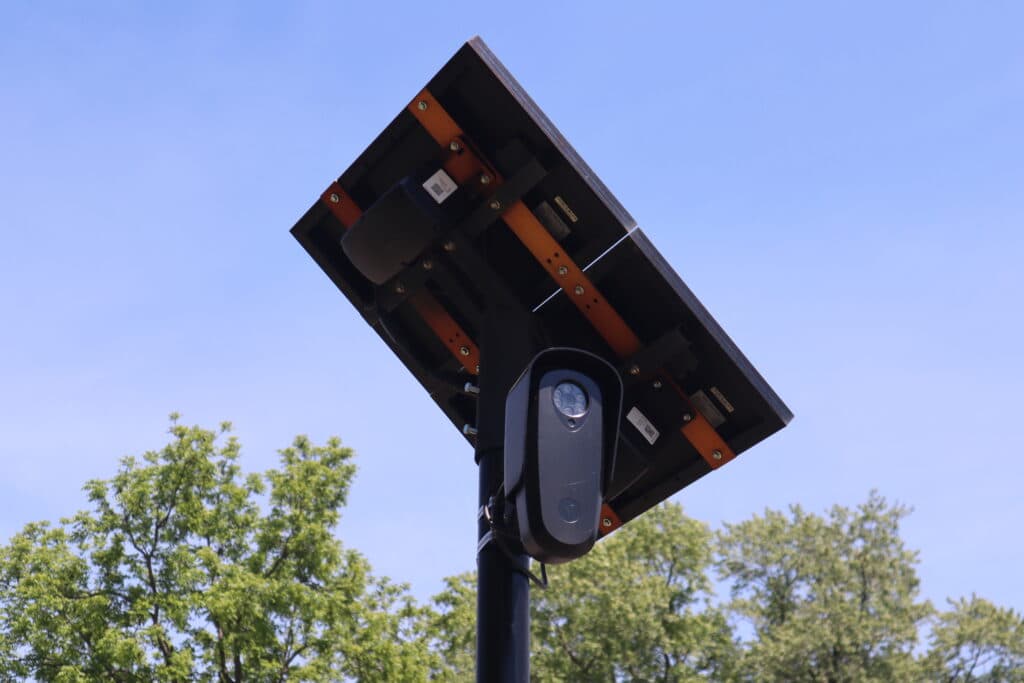


Controversy over Flock license plate reading cameras has rippled across Wisconsin, causing people to fill public hearings as some regions remove the cameras, and others overhaul auditing and oversight. Activists, elected officials and police departments are navigating disagreements over privacy, safety, freedom and the facts about the surveillance network.
Communities including Dane County, Verona, Monona, Fitchburg, Appleton, Oshkosh and Sturgeon Bay are dropping contracts with the multi-billion company Flock Safety because of heightened awareness and public anxiety over surveillance.

Officers and deputies from three different agencies and three separate counties stand accused of misusing Flock cameras, which compile images of vehicles and their license plates into a database which can be searched by police. When the Examiner reviewed five months of Flock data last year, it contained many thousands of searches conducted by 221 Wisconsin law enforcement agencies.
All three officers are accused of tracking their romantic partners, with officers Josue Ayala of Milwaukee and Cristian Morales of Menasha facing charges for which they have upcoming court appearances. Ayala is scheduled for sentencing in June and Morales has a jury trial in July. Kenosha County Deputy Frank McGrath was not charged for misconduct over his use of Flock to track another deputy he was dating and a John Doe petition seeking charges in the case has been sealed by a judge, according to court records.
“It’s powerful technology,” Heba Mohammad, an organizer with Milwaukee4Palestine — one of the local groups pushing against Flock cameras — told the Examiner.
Milwaukee4Palestine has focused on police surveillance as cameras, automatic license plate readers like Flock, and facial recognition technology and drones came to Milwaukee. “As Palestinians, we know what that is a signal of,” said Mohammad, pointing out that similar surveillance tested on Palestinians in Gaza and the West Bank has been adopted by U.S. law enforcement agencies. “The road to fascism is paved with well-intentioned surveillance technology.”
Milwaukee4Palestine organized to oppose facial recognition technology and then Flock. “We know this is what is next,” said Mohammad. “We’ve seen how surveillance can be used to oppress people.”

Although MPD stands by its use of Flock, the department has also been forced to revamp its auditing procedures. Over the last couple of months, the department has limited the number of officers who have access to Flock. James Lewis, risk manager for MPD, told the Wisconsin Examiner that access was restricted to an “as needed basis,” and that requests need to go through the chain of command, creating more of a paper trail when Flock is used.
While some units or bureaus investigating serious crimes had clearer needs for Flock, “in patrol, we wanted to make sure that the officers who had it really had the need to have this software,” said Lewis. MPD is also using audit data to flag “outlier” data that indicate questionable Flock uses, such as an officer searching the same vehicle multiple times over a short period, or not attaching case numbers to searches. MPD shares its Flock network with state partners, but not with federal agencies.
Nevertheless, community members have expressed a lack of confidence and trust in MPD surveillance, especially after the passage of Act 12, which stripped some of the Fire and Police Commission’s oversight powers in exchange for allowing Milwaukee to adopt a sales tax.
“We are of the position that the risks far outweigh the benefits of this technology and again, particularly with a police force like the Milwaukee Police Department that has been granted a lot of impunity through Act 12 [and has] basically no accountability,” said Mohammad. “And they are demonstrating time and time again that they don’t care what the community thinks.”
Lewis said that the department is trying to nail down exactly how Flock affects the community. “I think a lot of what we’ve seen through public comment, through the commissioners’ comments, through news media coverage for this is, ‘Hey this is this big data surveillance network and it’s got a lot of these pitfalls in it,” said Lewis. “But I think the other piece of it that we’re really trying to get our hands on is how is this making police work more efficient? Is it driving public safety outcomes? Are we getting what we want out of it and through audit, we’re trying to tell those stories as well.”
Lewis said MPD is working on answering some of those questions, especially the question of whether there is a return on investment in terms of public safety. “If there is outlier data generated, I want to know not just compliance or not, but also what did the city get out of this? Is it a safer place because of this?” Lewis said that MPD has chosen to overhaul its auditing practices on its own in a tailor-made fashion, rather than waiting on Flock Safety to develop a fix.
The department highlighted 24 different situations where Flock was used, including felony firearms investigations, parole violations, narcotics trafficking, homicide, material witnesses needed at criminal trials, stolen vehicles, overdose death investigations, sexual assault, shootings and armed robberies. In one of the examples involving theft, MPD specified in an email that “Flock was used to develop patterns of movement in the suspect vehicle” to determine whether it was related to other thefts.
Balancing tracking, privacy, and public safety
The extent to which Flock can track and surveil people has been a source of tension at public meetings. In December, Milwaukee County Sheriff Denita Ball and Chief Deputy Brain Barkow said that calling Flock a form of tracking is a misrepresentation. They argued that although Flock alerts officers that a vehicle has been sighted, they would still need to go to the area of the alert and search for the vehicle. In other words, Flock doesn’t see everything.
But the technology appears to have greater surveillance capabilities than some departments and even Flock itself have described.
The Waukesha County Sheriff’s Department has also said that Flock is “not used for general surveillance, traffic enforcement, or monitoring individuals not connected to an investigation.” However, the agency’s Flock data shows that officers entered “surveillance” and “traffic offense” as reasons for searching the camera network.

Oshkosh officials voted to continue a Flock contract only to reverse course the next day, saying that they’d been misled by Flock representatives over the camera’s ability to produce heat maps visualizing where a vehicle has been. At a meeting in April, Oshkosh Police Chief Dean Smith told local elected officials that because of that “misrepresentation” he could “I can no longer recommend Flock.”
“I think it depends on how it’s used,” Green Bay Police Chief Chris Davis told the Examiner. “I think if it’s misused, you can misuse this technology in a way that would allow you to track someone.” Yet, Davis feels that Flock can be an asset when used for legitimate criminal investigations. “I think people sometimes misunderstand how the technology works.”
Davis concedes of Flock use that in some ways, “yeah, that’s kind of tracking someone. But I have a legitimate criminal predicate for doing so.” At the same time, he condemns the use of Flock for personal reasons, like spying on ex-wives or partners. “The government doesn’t get to do that,” said Davis. “That’s unlawful overreach into someone’s life because there’s no legitimate public safety reason for getting access to that data.”
Davis was hired at Green Bay in late 2021, when the city was experiencing a rise in gun violence. After deciding not to adopt gunshot detection tech, the city pivoted to automatic license plate readers.
“At the time Flock was one of very few, if not the only company that had stationary license plate reader technology,” said Davis. “With gun crimes, the faster you can develop a suspect and make an arrest, the better, because there’s a retaliatory cycle that happens.” The department has been able to locate homicide suspects who fled to other states, hit-and-run suspects, and stolen vehicles using Flock.
Davis said that “license plate reader technology has been a game changer for all of us. On the other hand, you still have to take people’s privacy concerns seriously.” He stressed that “anytime you’re collecting that much data about people as they just go about their daily business, you have to be really careful with how that’s used.”

How Flock can be layered with other surveillance technologies also worry community members. In May, officers in Wauwatosa used Flock surveillance and a drone to track a robbery suspect.
The debate reminds Davis of the words of a mentor, that being a police chief is “the great balancing act of municipal government.” He added that, “I think it would be a mistake for us to not take people’s privacy concerns seriously in this conversation.”
As cases of misuse have popped up, the Green Bay Police Department has also tightened its use of Flock. They used their own audit to look for suspicious searches, and didn’t detect any instances of misuse. “We didn’t find any of that in our audit that we did, but it doesn’t hurt to ratchet it down as much as we can,” said Davis. “Because again, I understand, like you’re talking about people’s sensitive information. We have to be responsible with how we use that, and there have to be safeguards in place.”
The department has also restricted which outside agencies can access its Flock network. While there was an initial belief that “the bigger the network, the more valuable the tool,” Davis said that Green Bay PD has “re-thought that over the last few weeks.” Now only agencies in the Upper Peninsula of Michigan, eastern Wisconsin from Green Bay to Milwaukee, and the Chicagoland area (including Racine, Kenosha, and Cook counties along with some Chicago suburbs and a small portion of Indiana around the city of Gary) can search within Green Bay’s network.
“We figure that makes more sense to have more of a rationale for why we share data,” said Davis. “Because I don’t have control over how those other agencies manage their employees. It’s not that I don’t trust them, but if they want that information then they can call us and they can explain what they’re working on, and we’ll see if we can help them.”

Green Bay PD is also utilizing a drop down menu with pre-designated options for using Flock, rather than allowing officers to type whatever they want. When the Examiner conducted its first analysis of Flock last year, there were several departments which used vague search terms, even just putting a dot or “.” as the reason for searching Flock. When the Examiner brought it to the Waukesha Police Department’s attention, the department said an officer was re-trained and counseled.
Captain Dan Baumann of the Waukesha PD said in an email statement that since then, the department has “strengthened its oversight of Flock Safety by increasing formal audits from twice per year to monthly.” There are also random audits in addition to the mandatory audit, as well as an AI-powered Flock audit assistance tool to flag suspicious searches. The department’s standard operating procedure has also been adjusted. No further instances of vague labeling have arisen, and no discipline has been issued in connection to use of Flock.
Baumann said Flock has assisted investigations such as in a vehicle break-in where leads were limited, and using Flock allowed investigators to identify a suspect’s vehicle and connect it to cases in Dane County. Flock was also used to locate someone involved in a shooting, and who pointed a gun during a road rage incident, Baumann said.
Communities waking up to surveillance risks
While it may be encouraging that departments are changing procedures and upping auditing, advocates still have questions about whether it will be enough. Jon McCray Jones, policy analyst for the American Civil Liberties Union (ACLU) of Wisconsin, hopes that people “don’t miss the forest for the trees” by focusing solely on Flock, when other companies sell similar technology.
“I don’t believe that law enforcement are just acting out of good faith with a lot of these regulatory changes and auditing changes to Flock,” McCray Jones told the Examiner. “I believe that it comes from sustained pressure started at the most local level from people understanding and realizing the dangers associated with all these cameras and automated license plate readers, and specifically Flock, who is the worst company out of all of them so far.”

It all also ties back to a growing mistrust and fear over the federal government. Under President Donald Trump, federal immigration agents have flooded Democratic-led cities across the country, resulting in multiple shootings and deaths in Minnesota earlier this year. The Trump administration has also directed federal agencies to begin investigating left-wing groups it has accused of domestic terrorism.
Mohammad said that the ICE surges really brought surveillance to the forefront when people began to see “ICE agents scanning people’s faces in different cities, and telling them that we have a database and we can recognize your name. Or pulling people’s license plates and figuring out what their names were so that they could harass them directly by name.” She added, “I think this political moment is also a moral and ethical one.”
McCray Jones also said the issue of police surveillance has new urgency as communities are “being targeted and their neighbors being disappeared by the federal government.” ICE and other federal agencies have access to Flock either directly, or through assistance from local and state agencies which have contracts with the company. Public officials, under pressure from voters, are “jumping on board,” McCray Jones said, “and they’re feeling courageous and empowered to take on these surveillance systems.”
Public meetings about surveillance technology in Milwaukee are energized, Mohammad said. “I don’t want to say exciting because I think that really betrays the seriousness of the moment,” she said. “But there is that buzz that often happens when that room is full, or there was a time when they had to open the overflow room.” It’s shown Mohammad that “people care about this stuff and that’s why I think that it’s really incredible that even though the FPC doesn’t really have any teeth to its accountability anymore, we as residents are using as many avenues as are open to us to make our voices heard.”

McCray Jones suggests that people care about Flock because “at its core, it’s one of the easiest surveillance technologies for people to understand.” He believes that people understand that “anyone who drives is impacted by this technology in a way that other surveillance technologies, say like ShotSpotters or Stingray…I think people have a harder time one: knowing how these technologies work but two: viewing themselves as potential victims.”
He added that in several cases, including in Milwaukee, officers who misused the technology were caught by people using websites like HaveIBeenFlocked, not by the department. “So we don’t know how much these systems are being abused,” he said. “And I think elected officials should use these moments of high, intense scrutiny from the community and in the media, and having anecdotal stories of officers doing this right now, to really be courageous and take the lead to fight for more accountability measures before the public forgets about this story, and forgets about the danger that they are under due to law enforcement’s ability to track where you are at all times.”
Mohammad said that she and her allies are not quitting anytime soon. “We understand our position, we understand the risks here,” she told the Examiner. “And so we’re not going to back down. We do not want our communities to be surveilled. And we believe that public safety comes from investments in other areas, not in police surveillance.”